
Sustainable Management
01 Sustainability Vision
Environmental
-
Conduct regular greenhouse gas (GHG) inventories to monitor emissions, continuously promote energy conservation and carbon reduction initiatives, and proactively respond to climate change.
-
Enhance resource recycling and reuse to promote circular economy development, with focused management of water, waste, and air pollutants through appropriate pollution prevention measures.
-
Promote renewable energy adoption in facilities and production processes to reduce energy consumption and carbon emissions.
Social
-
Provide safe, healthy work environments while ensuring workforce diversity, protecting human rights, and enhancing employee satisfaction.
-
Offer fair compensation, professional training, and development programs to promote human capital sustainability and create long-term employee value.
-
Engage actively in community welfare initiatives and encourage employee participation in social responsibility programs.
-
Ensure supply chain partners maintain safe work environments, respect employee dignity, and uphold business ethics and environmental responsibilities.
Governance
-
Maintain robust corporate governance systems, uphold business ethics standards, and comply with applicable laws to create company value and protect shareholder interests.
-
Enhance information disclosure and transparency through effective stakeholder engagement and balanced reporting.
-
Establish anti-corruption mechanisms and compliance frameworks to ensure business integrity, report ESG performance regularly to stakeholders, and continuously improve sustainability strategies.
-
Foster board diversity and independence to enable effective governance and decision-making.
02 Sustainability Governance Framework
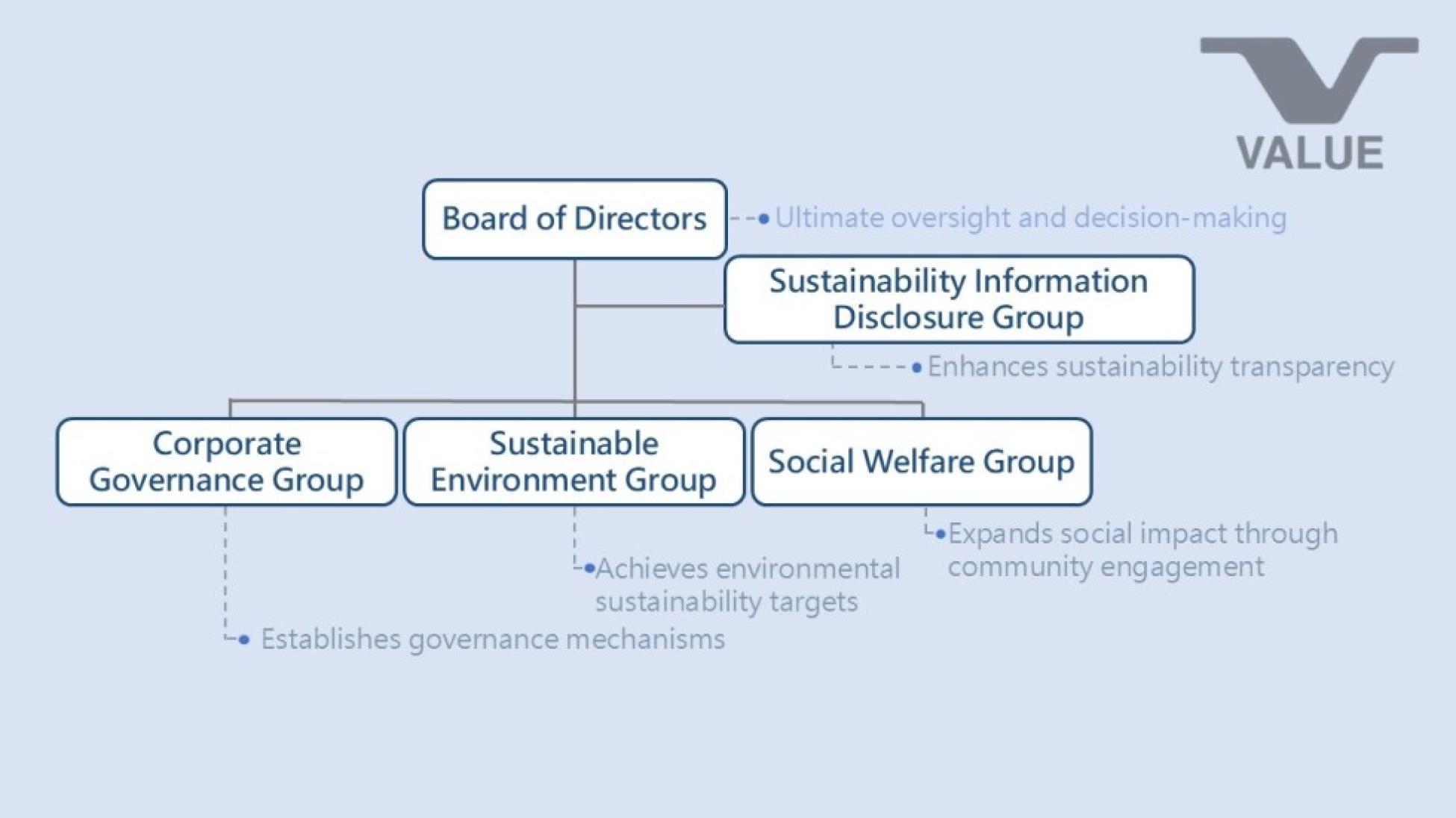
To implement our ESG vision and mission, we established a Sustainability Committee as our internal sustainability governance unit. The Committee is chaired by the Chief Sustainability Officer and includes three working groups: Corporate Governance, Environmental Sustainability, and Social Responsibility, each led by a designated manager.
Each group identifies material ESG issues in company operations and develops management strategies and targets.
03 Stakeholders and Material Topics
| Significance to Value Valves | Key Issues | Communication Methods and Frequency | |
|---|---|---|---|
|
Employee |
Employees are the Company's most important asset, driving growth through their efforts and creativity. We create a safe, inclusive workplace where team members feel valued and engaged, working together toward shared success. |
|
|
| Customer |
Customers are valued partners whose needs guide our direction. We provide reliable products and services to build trusted, long-term relationships that benefit all parties. |
|
|
| Supplier |
Suppliers are key partners essential to our success. We foster mutual trust and collaboration to enhance efficiency, create value, and achieve shared goals of quality supply chains and sustainable development. |
|
|
|
Government |
Government agencies provide guidance and support for our stable development. Their regulations and assistance enable compliant growth. We respond to expectations through concrete actions, contributing to social progress and industry development. |
|
|
|
Shareholder / Investor |
Shareholders and investors are supporters whose trust drives our progress. We respond through transparent management and solid performance, working together to achieve sustainable value creation and shared success. |
|
|
| Communities |
Local communities are our foundation, and we share growth outcomes with our neighbors. We value these connections and create positive impact through environmental protection and community activities, fostering a harmonious living environment. |
|
|
| Media |
Media serves as our bridge to communicate with the world, helping us convey brand values and principles through their reporting and insights. We respond through sincere and transparent communication, working together to build positive reputation and social image. |
|
|
Materiality Analysis
The Company follows the four AA1000 accountability principles of Materiality, Inclusivity, Responsiveness, and Impact, and applies GRI 3: Material Topics 2021 to further assess the significance of material topic impacts on economic, environmental, and human rights aspects. The implementation steps are as follows:

Identification
Understanding Organizational Context
When developing the sustainability topic list, the Company considers core operations, key business resources, supply and value chain processes, and international sustainability issues. This resulted in 17 topics across 6 Governance, 6 Social, and 5 Environmental categories.

Analysis
Identifying and Assessing Impact Significance
Based on identified topics, the Company evaluates actual and potential positive and negative impacts for each sustainability topic.
Prioritizing Impacts
Through stakeholder surveys and internal/external analysis, the Company assesses impact probability and severity, calculates averages, and ranks topics by operational importance. In 2024, we collected 101 questionnaires, of which 85 were valid responses used as the basis for this prioritization.

Confirmation
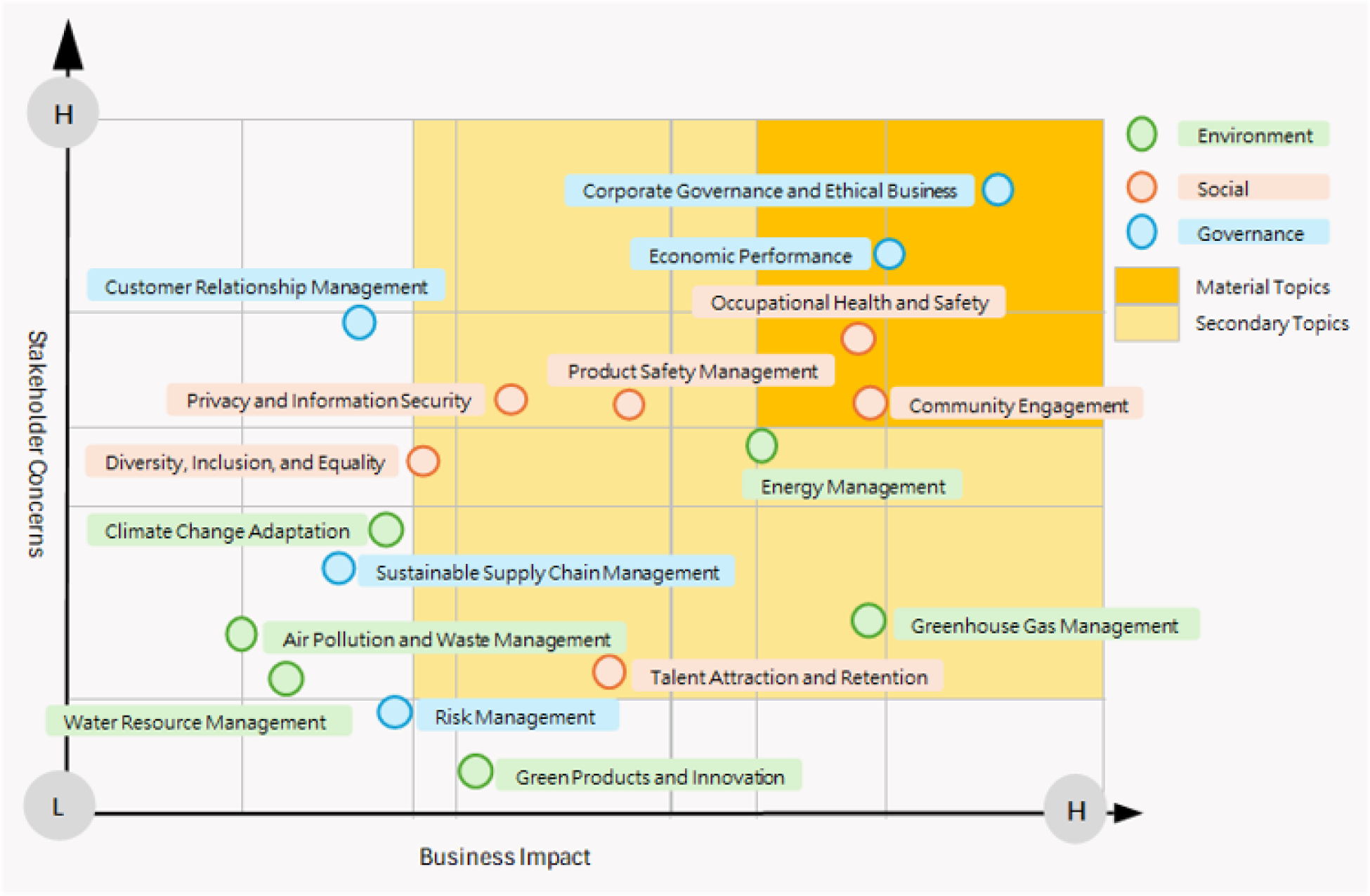
The working group selects major and secondary topics as this year's material issues (totaling 10 topics)
Material Topics
Our materiality matrix evaluates topics using stakeholder concerns (Y-axis) and operational impact assessed by senior management (X-axis) through dual-axis analysis.